Wonderful Pandawa: A Script Font That Balances Elegance and Whimsy
I remember the moment I opened a new brand board for a local artisan bakery looking to refresh their packaging and digital presence. The brief called for something warm, inviting, and a little playful — but still refined enough to feel premium. I had a few script fonts lined up, but when I typed out the bakery’s name in Wonderful Pandawa, I paused. It just… worked.
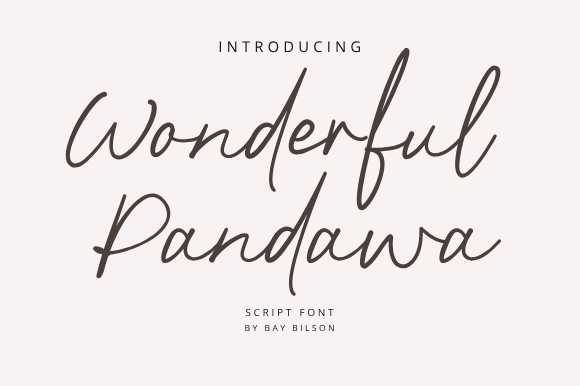
Wonderful Pandawa is a script font that blends elegance with a subtle sense of whimsy. Its flowing strokes and soft curves give it a graceful, almost calligraphic feel, while the slight bounce in its rhythm keeps it from feeling too formal or stuffy. It’s the kind of font that reads as both timeless and modern — a balance that’s harder to achieve than it sounds.
Testing Wonderful Pandawa Across Brand Touchpoints
From the start, I knew this font would shine in logo design. I dropped it into a simple wordmark layout for the bakery and was immediately struck by how well it held its own. The baseline flow and letter spacing made it feel custom-drawn, even though it was just a clean vector shape. It didn’t need much — a soft color palette and a minimalist icon were enough to let the typography carry the identity.
Next, I tested it on packaging mockups. The bakery’s new line included kraft paper bags and small label stickers for jam jars. At smaller sizes, Wonderful Pandawa held up surprisingly well — especially when I used it in a bolder weight. The swashes and ligatures were subtle enough not to overwhelm the design, but still added a touch of personality.
When it came to digital applications, like social media graphics and website headers, Wonderful Pandawa performed consistently. I used it on Instagram story templates and homepage hero sections, where its elegant curves helped draw attention without being over the top. On the website, I paired it with a clean sans serif for body text, which created a nice visual contrast and hierarchy.
Where Wonderful Pandawa Shines — And Where It Needs Care
Let’s be clear: this is not a font for long body copy. It’s a display font at heart, best used for short phrases, headlines, and accents. I tried it once in a blog post header and it worked beautifully — but I wouldn’t use it for more than a line or two of text.
Wonderful Pandawa’s personality makes it ideal for:
- Logo design
- Brand headers and taglines
- Packaging labels and product names
- Social media posts and stories
- Business cards and stationery
- Wedding invitations and boutique branding
That said, I wouldn’t recommend it for formal corporate identities or long-form editorial layouts. It has a charm that leans more expressive than professional, so context is key. If you’re designing a law firm’s brand or a technical report, this probably isn’t the right choice.
Font Pairing and Practical Design Tips
One of the biggest pluses of Wonderful Pandawa is how well it pairs with other typefaces. I tested it with several combinations and found that a modern serif or a clean sans serif brought out its best qualities without competing for attention. For example, pairing it with a geometric sans like Montserrat or a classic serif like Playfair Display gave the design a balanced, intentional feel.
It also comes with multiple stylistic alternates and ligatures, which helped me customize the look for different brand assets. The swashes added a nice flourish on packaging labels, while the simpler alternates worked better for digital use where clarity was more important.
If you’re planning to use Wonderful Pandawa in your next project, here are a few tips:
- Test it at different sizes — especially if it’s going on physical products like labels or signage.
- Use the alternate characters to avoid repetition and enhance visual flow.
- Pair it with a neutral font to balance its expressive nature.
- Make sure to check the licensing if you’re using it in commercial design assets, merchandise, or templates.
Final Take: A Versatile Script Font for Expressive Branding
After using Wonderful Pandawa across a full branding project — from logo mockups to packaging labels and digital layouts — I can confidently say it’s a solid addition to any designer’s toolkit. It’s expressive without being overwhelming, elegant without feeling outdated, and flexible enough to work across both print and digital mediums.
If you’re working on a boutique brand, a creative studio identity, or a small business that wants to stand out with a human touch, Wonderful Pandawa is worth trying. Just be mindful of its limitations and always test it in context before locking in your final designs.